
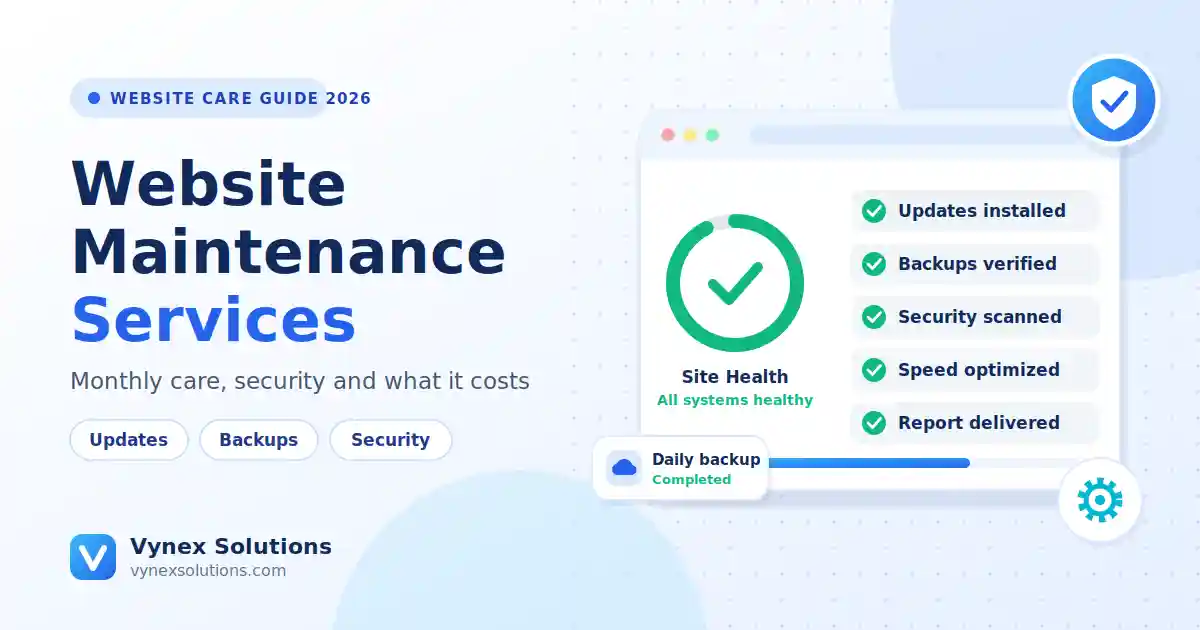
Website maintenance services are the recurring tasks that keep a business website secure, fast and generating leads: software updates, backups, security monitoring, performance checks and form testing. Small and mid-sized business sites typically cost $50 to $500 a month to maintain, while ecommerce sites run roughly $300 to $1,000 a month. Most of that spend goes to prevention, and prevention costs far less than recovering from a hack or a silent lead leak. godaddy
Most B2B websites are not neglected on purpose. The launch goes well, the team moves on, and nobody owns the site afterward. Then a plugin update breaks the contact form, and the quote requests that should have arrived never do.
This guide covers what a monthly plan should include, what it costs, and how to judge a provider before you sign anything.
What are website maintenance services?
Website maintenance services are ongoing technical care that protects the investment you made in your site. They cover updates, backups, security, speed, uptime and testing.
They usually do not cover new pages, redesigns, content writing or ad management. Those are projects, not maintenance. Confirm that boundary in writing, because “maintenance” means different things to different vendors.
Why does a working website still need monthly care?
1. Security risk is concentrated in plugins.
Patchstack counted 11,334 new WordPress ecosystem vulnerabilities in 2025, a 42% increase over 2024, and 91% of them were in plugins. The practical takeaway is that the more plugins your site runs, the more you have to watch. swif
There is a second problem. Patchstack’s data shows that roughly 45–46% of WordPress vulnerabilities had no patch available when they were publicly disclosed. Clicking “update” is therefore not a complete defense. A good plan adds monitoring and, where possible, a way to block known exploits while a fix is pending. jorijn
2. Speed affects both rankings and conversions.
Google’s Core Web Vitals targets are LCP of 2.5 seconds or less, INP of 200 milliseconds or less and CLS of 0.1 or less, measured at the 75th percentile of real users. Only 48% of mobile websites pass all three, according to the 2025 Web Almanac. New plugins, tracking scripts and large images erode these scores over time, which is why speed needs regular review. specificationbsscommerce
3. Silent failures cost leads.
Broken forms, expired SSL certificates and failed email delivery rarely announce themselves. If your site gets visits but few inquiries, check these before you spend more on traffic. We cover the other causes in why your website gets traffic but no leads.
4. Online stores face compliance deadlines.
If you take card payments, PCI DSS v4.0.1 applies. Requirement 6.3.3 requires patches for critical vulnerabilities to be installed within one month of release. A store without a patching routine will struggle to show that it meets this. Check with your payment processor how the rule applies to your setup. oneuptime
What should a WordPress maintenance plan include?
| Task | Typical frequency | What it protects against |
|---|---|---|
| Core, plugin and theme updates | Weekly, tested on a staging copy | Known vulnerabilities, compatibility breaks |
| Off-site backups | Daily for active or ecommerce sites | Hacks, failed updates, human error |
| Malware and security scanning | Daily or continuous | Undetected compromise |
| Uptime monitoring | Every 1–5 minutes | Unnoticed downtime |
| Speed and Core Web Vitals review | Monthly | Ranking and conversion loss |
| Form, checkout and email testing | Monthly | Lost leads and orders |
| Broken links and Search Console errors | Monthly | Crawl issues, poor user experience |
| SSL, domain and license renewals | Tracked all year | Browser warnings, site outages |
| Monthly report | Monthly | Accountability |
How website security updates should work
Updates should never go straight to your live site. A competent provider tests them on a staging copy, checks key pages and forms, then deploys with a rollback ready. Critical security fixes get priority over cosmetic updates.
What a good website backup looks like
A backup stored on the same server as your website is not much protection, because a server failure or compromise can take both. Look for four things:
- Off-site storage in a separate location
- Multiple retained versions, not just the latest copy
- Daily backups for sites that take orders or inquiries
- A restore test, because an untested backup is only an assumption
How much does website maintenance cost in 2026?
Published ranges vary by source, so treat all of them as starting points rather than quotes.
| Site type | Typical monthly range |
|---|---|
| Blog or brochure site | $5–$75 |
| Small business site | $50–$500 |
| Ecommerce store | $300–$1,000 |
| Corporate site | $1,000–$5,000+ |
For a reality check on productized plans, published care plans read on 1 September 2026 started at $69 a month for small sites and reached $359 a month at the top of one provider’s four tiers. Some agencies price higher. One agency guide puts typical total spend for many businesses between $500 and $2,500 a month. The gap usually comes from scope: hosting, unlimited edits and response times are bundled in some plans and excluded from others. axonbuildgravitatedesign
What pushes the price up
- Plugin count. Fewer, better-chosen plugins mean less to update, test and secure.
- Ecommerce. Checkout, payment and inventory plugins need more careful testing.
- Custom code. Custom themes and integrations take longer to update safely.
- Response time. A guaranteed one-hour response costs more than “we’ll get to it”.
- Included edits. Content changes and support hours add to the price.
Three common pricing models
- Bundled with hosting. This is the cheapest option, often $20 to $60 a month, and usually means basic upkeep only. apexure
- Fixed scope. A defined list of tasks for a set fee.
- Hours bank. You buy a block of hours and the provider reports how they were used.
Be cautious about long lock-ins. One industry guide lists a twelve-month contract for a small site as a red flag. Month-to-month terms let you leave if the service disappoints. apexure
What does skipping maintenance actually cost?
Use your own numbers rather than industry averages:
Annual risk cost = (monthly revenue or lead value ÷ 30) × days of downtime or lost leads × number of incidents per year
Hypothetical example, not a real client result: if your site brings in 40 inquiries a month and a broken form goes unnoticed for 10 days, you lose roughly 13 inquiries. If one in five becomes a customer, that is about 2–3 lost deals. Add the cleanup cost if the cause was a hack, and a plan at $100–$300 a month looks inexpensive.
DIY, in-house or agency?
| Option | Works best when | Watch out for |
|---|---|---|
| DIY | Small brochure site and a technical owner | Missed updates, no backup testing, no 24/7 monitoring |
| In-house developer | Large or custom site | Single point of failure when that person is away |
| Agency or specialist | Lead-generating or ecommerce site | Vague scope, slow response, lock-in contracts |
How to choose a website maintenance provider
Ask these seven questions before you sign:
- Do you test updates on a staging site before going live?
- Where are backups stored, and how often do you test a restore?
- What is your response time for a site-down emergency?
- Which tasks are included, and which are billed extra?
- Who is responsible if an update breaks the site?
- Will I get a monthly report showing what was done?
- Can I cancel on 30 days’ notice?
When maintenance is not the answer
If every update breaks something or the platform no longer fits your business, maintenance only delays the problem. Read the hidden cost of a cheap website to judge whether a rebuild makes more sense.
FAQs
How much do website maintenance services cost per month?
Most small business sites pay between $50 and $500 a month, and ecommerce stores typically pay more. Scope matters more than the headline price, so compare what each plan includes.
What is included in a WordPress maintenance plan?
A solid plan covers core, plugin and theme updates, off-site backups, security scanning, uptime monitoring, speed checks, form testing and a monthly report.
How often should a business website be maintained?
Security monitoring and backups should run daily or continuously, updates weekly, and a full review monthly.
Is website maintenance necessary if my site works fine?
Yes. Most serious problems, such as outdated plugins, failing backups and broken forms, are invisible until they cause damage.
Can I handle website maintenance myself?
You can, if you have the technical skill and the time to update, test and restore reliably. Most business owners find a provider cheaper than the hours and risk involved.
What is the difference between hosting and website maintenance?
Hosting keeps your site online and its servers running. Maintenance keeps the software on top of it updated, secure and working. Some hosts bundle basic upkeep, but it is usually limited.
How often should I back up my website?
Daily for sites that change often or take orders, and weekly may be enough for a static brochure site. Whatever the schedule, test a restore regularly.
Get a clear view of your site’s health
If you are unsure what your website needs, a short audit is a sensible first step. Vynex Solutions offers WordPress, WooCommerce and Shopify maintenance, and you can request a free website health check to see where your site stands before choosing a plan.