If your business needs more leads, you may be wondering: Should you build a full website or a dedicated landing page?
The answer depends on where your visitors come from, what you want them to do, and how much information they need before making a decision.
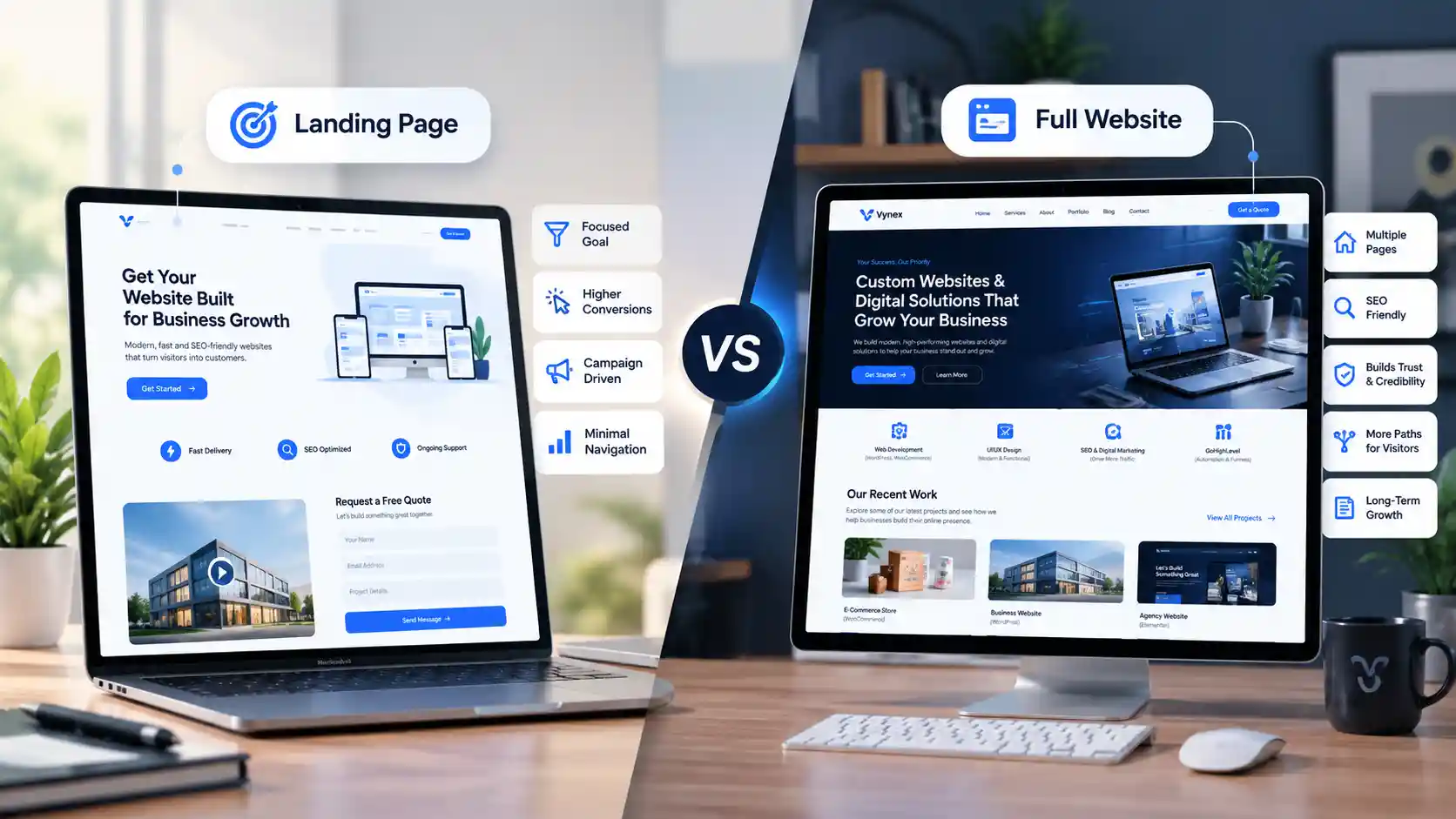
A website helps people discover, understand, and trust your business. A landing page is designed to move a specific visitor toward one action, such as booking a call, requesting a quote, or submitting a form.
For many businesses, the most effective approach is not choosing one over the other. It is using a website for long-term growth and landing pages for focused campaigns.
Landing Page vs Website: Quick Answer
| Factor | Landing Page | Full Website |
|---|---|---|
| Main purpose | One conversion goal | Complete online presence |
| Best for | Paid campaigns & specific offers | SEO, brand & multiple services |
| Navigation | Minimal or none | Full navigation |
| Content | Focused | Broader |
| Primary CTA | Usually one | Multiple |
| SEO potential | Limited to specific page | Stronger long-term structure |
| Best traffic | Ads, email, social campaigns | Google, referrals, direct traffic |
| Ideal use | Generate targeted leads | Build authority and trust |
The important point is that a landing page and a website solve different problems.
What Is a Landing Page?
A landing page is a focused web page created around a specific audience, offer, and conversion goal.
For example, a digital marketing agency might create a landing page specifically for:
- Free SEO consultation
- Google Ads management
- WordPress website development
- Local SEO services
- Free website audit
Instead of asking visitors to explore the entire business, the page guides them toward one specific action.
A typical lead-generation landing page includes:
- A clear headline
- Specific offer
- Short explanation of benefits
- Social proof or testimonials
- Relevant trust signals
- Simple lead form
- Strong call-to-action
- FAQ or objection handling
The goal is clarity rather than completeness.
What Is a Business Website?
A business website is a broader online presence containing multiple pages and multiple paths for visitors.
A typical service business website may include:
- Homepage
- Service pages
- About page
- Contact page
- Portfolio or case studies
- Blog
- FAQs
- Location pages
- Privacy and legal pages
Visitors may arrive with completely different questions.
Someone searching for your service may want pricing. Another visitor may want to see previous projects. Someone else may want to understand your process before contacting you.
A website gives each visitor room to explore.
It also provides a stronger structure for building organic search visibility through service pages, helpful content, internal links, and supporting resources.
When Should You Use a Landing Page?
A landing page makes sense when the visitor already has a relatively specific intent.
1. You Are Running Paid Ads
If you are paying for Google, Meta, LinkedIn, or other advertising traffic, sending every visitor to your homepage may create unnecessary friction.
For example:
Ad:
“Professional WordPress Website for Small Businesses”
Landing page:
“WordPress Website Development for Small Businesses”
The closer the message is between the ad and the page, the easier it is for the visitor to understand that they are in the right place.
2. You Have One Specific Offer
If you are promoting one service, product, consultation, or promotion, a dedicated page allows you to focus the entire experience around that offer.
3. You Want More Focused Conversion Tracking
A landing page can have a clearly defined conversion event, such as:
- Form submission
- Phone call
- Appointment booking
- Quote request
- Demo request
This makes campaign performance easier to analyze.
4. You Want to Test Different Messages
Landing pages are also useful for testing different headlines, offers, CTAs, and page structures before applying successful messaging elsewhere.
When Do You Need a Full Website?
A full website becomes more important when your business needs long-term visibility and credibility.
1. You Want to Grow Through SEO
SEO usually requires more than one page.
A website can support:
Service pages → Blog content → Internal links → Supporting pages → Conversion pages
This creates a structure that helps users discover information while allowing search engines to understand the different topics your business covers.
2. You Offer Multiple Services
If you provide WordPress, WooCommerce, Shopify, SEO, and digital marketing services, putting everything on one landing page can make the experience confusing.
Separate service pages allow you to explain each offering properly.
3. Customers Need to Research Before Contacting You
B2B buyers often want to understand:
- Who you are
- What you offer
- Whether you have relevant experience
- How your process works
- What other clients say
- What questions you can answer
- How to contact you
A full website gives them that information.
4. You Want to Build Long-Term Brand Authority
Your website becomes the central location for your brand, content, services, case studies, and customer resources.
That makes it more useful as your business grows.
Landing Page or Homepage for Paid Ads?
This is one of the most important decisions in lead generation.
Suppose someone clicks an ad for:
“WooCommerce Development Services”
If they arrive on your homepage, they may see:
- WordPress
- Shopify
- SEO
- Web design
- About us
- Blog
- Multiple CTAs
The visitor now has to figure out where to go.
A dedicated WooCommerce landing page can instead immediately communicate:
WooCommerce Development Services → Benefits → Portfolio → Process → FAQs → Contact
That reduces unnecessary choices and keeps the page aligned with the visitor’s original intent.
A landing page is therefore often more appropriate for a specific paid campaign, while the homepage remains the broader entry point for your business.
Can a Landing Page Rank on Google?
Yes.
A landing page can be optimized for search, but that does not mean every landing page should be treated as a primary SEO page.
A long-term SEO strategy usually benefits from a broader website structure containing relevant service pages and useful supporting content.
For example:
Main service:
WordPress Development
Supporting pages:
- WordPress Website Development
- WooCommerce Development
- WordPress Maintenance
- Elementor Development
Supporting content:
- WordPress Website Cost
- WordPress vs Shopify
- Website Performance
- Website Redesign
- Common Website Conversion Problems
This structure gives both users and search engines more context.
What Makes a Lead Generation Landing Page Effective?
A landing page does not convert simply because it has a form.
The entire experience matters.
Use a Clear Headline
Tell visitors exactly what they are getting.
Weak:
We Build Digital Experiences
Stronger:
Custom WordPress Websites for Growing Businesses
Match the Visitor’s Intent
The page should answer the same problem that brought the visitor there.
If the visitor searches for WooCommerce development, the page should immediately discuss WooCommerce—not your entire list of services.
Keep the CTA Specific
Instead of generic:
Submit
Try:
Request a Free Quote
or:
Book a Consultation
Reduce Form Friction
Only ask for information you actually need at that stage.
A simple inquiry may need:
- Name
- Phone
- Project details
A long form asking for unnecessary information can create additional friction.
Add Trust Signals
Depending on your business, consider:
- Client testimonials
- Portfolio
- Case studies
- Certifications
- Years of experience
- Guarantees or policies
- Clear contact information
Trust is particularly important when the visitor does not already know your company.
Website + Landing Pages: The Better Long-Term Structure
For many growing businesses, the strongest setup is:
Website + Dedicated Landing Pages
Your website handles:
- Organic search
- Brand credibility
- Service discovery
- Educational content
- Long-term authority
Your landing pages handle:
- Paid campaigns
- Specific offers
- Lead magnets
- Seasonal promotions
- Targeted audiences
- Conversion-focused campaigns
For example:
Business Website
→ Homepage
→ Services
→ About
→ Portfolio
→ Blog
→ Contact
Campaign Landing Pages
→ WordPress Development
→ WooCommerce Development
→ Free Website Audit
→ SEO Consultation
→ Google Ads Campaign
This creates a clearer customer journey instead of forcing one page to do everything.
Common Mistakes Businesses Make
Sending Every Ad to the Homepage
A homepage is designed for multiple visitors. A campaign landing page is designed for a specific audience and offer.
Using Too Many CTAs
Five different actions can make the visitor unsure what to do next.
Removing All Trust Information
A landing page should be focused, but it should still answer the visitor’s biggest concerns.
Building a Beautiful Page Without Tracking
If form submissions, calls, bookings, or other conversions are not properly tracked, you cannot reliably determine which campaigns and pages are generating leads.
Google Analytics supports measuring form interactions and configuring important actions as key events, making conversion tracking an important part of the overall setup.
Treating SEO and Conversion as the Same Job
SEO brings relevant visitors to your site. Conversion optimization helps those visitors take action.
You need both.
How to Decide What Your Business Needs
Ask these five questions:
1. Are you running paid advertising?
→ Consider dedicated landing pages.
2. Do you want long-term organic traffic?
→ Build a proper website and SEO structure.
3. Do you offer multiple services?
→ Use a full website with individual service pages.
4. Are you promoting one specific offer?
→ Build a focused landing page.
5. Do you need both SEO and paid lead generation?
→ Use both a website and campaign-specific landing pages.
Final Takeaway
A website is your long-term digital foundation. A landing page is a focused conversion tool.
The question is not simply whether a landing page is better than a website.
The better question is:
What does your visitor need to do, and where are they coming from?
For SEO, brand building, multiple services, and long-term growth, a full website provides the necessary structure.
For paid campaigns, specific offers, and focused lead generation, dedicated landing pages can create a more direct path to conversion.
For many businesses, the most practical strategy is to use both together—a strong website for long-term growth and targeted landing pages for campaigns and lead generation.
Frequently Asked Questions
Is a landing page the same as a website?
No. A landing page is generally designed around one specific goal, while a website provides a broader online presence with multiple pages and user journeys.
Is a landing page better for lead generation?
It can be, particularly when the visitor comes from a targeted campaign and the landing page matches the visitor’s intent. Results depend on traffic quality, offer, messaging, page experience, and follow-up.
Do I need a website if I have a landing page?
For a long-term business presence, a full website is usually useful. A landing page can support specific campaigns without replacing the broader website.
Can a landing page rank on Google?
Yes. A landing page can appear in organic search when it provides relevant, useful content and meets search-engine requirements. However, a broader website can provide more opportunities for building topical depth and internal linking.
Should Google Ads traffic go to my homepage?
Not necessarily. If the campaign promotes a specific service or offer, a dedicated landing page can provide a more focused experience than a general homepage.
How many landing pages does a business need?
There is no fixed number. Build landing pages around meaningful differences in audience, offer, service, location, or campaign intent rather than creating unnecessary duplicate pages.
Can a landing page and website use the same domain?
Yes. In many cases, keeping campaign landing pages on your business domain allows them to work alongside your main website and analytics setup.
Ready to Turn More Website Visitors Into Leads?
Your website should do more than look professional. It should help visitors understand your offer, build trust, and take the next step.
If your website or landing pages are not generating the leads you expect, Vynex Solutions can help you improve the structure, design, performance, SEO, and conversion experience.